The challenge
Automated rules can process large volumes of items, but the decisions they produce still need oversight. When flagged items accumulate faster than a team can inspect them, manual review becomes a bottleneck: operating costs grow with volume, decisions are delayed, and expert attention is consumed by repetitive work.
The initial solution was a manual script that used an LLM to help pre-screen decisions. It demonstrated the concept, but a production system needed predictable throughput, failure recovery, consistent evaluation, and a clear way to integrate AI recommendations into the existing decision workflow.
The product goal was straightforward: resolve routine reviews automatically, reserve people for uncertain cases, and make the economics sustainable at scale.
The review service
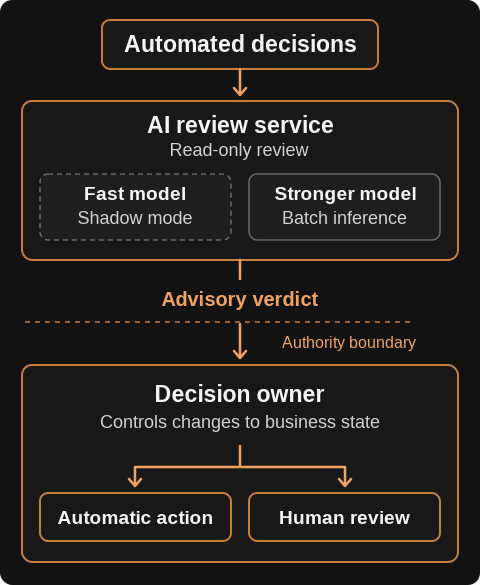
A standalone decision-review service was built to integrate with the existing decision workflow. It receives batches asynchronously, evaluates the relevant decision and context using category-specific, versioned prompts, then returns a recommendation with confidence, reasoning, and model provenance.
The service gives advice. Only the decision owner can change business state. The system that owns the decision determines which final recommendations can be applied automatically and which require human judgement. This keeps policy and accountability in the right place while making the reviewer reusable across different business workflows.
The architecture is event-driven and supports asynchronous batch inference, provider fallback, safe retries, traceability and operational monitoring. These capabilities keep the review workflow running at production volume.
Architecture
Business outcomes
- Automation at scale: The service processes millions of reviews per month. In the measured period, approximately 90% of final verdicts were applied automatically under the decision owner’s rules.
- Dependable operation: Batch-level failure rates below 0.1% in the measured production period.
- Human oversight where it matters: The decision owner can route uncertain or failed reviews to people.
- Room for continued optimisation: Versioned prompts and configurable provider chains allow the review strategy to evolve without rebuilding the surrounding business workflow.
Inference cost and model evaluation
Using a powerful model for every decision is simple, but unnecessarily expensive if many decisions can be handled by a smaller model.
A configurable two-stage review strategy was implemented. It lets a fast, lower-cost model evaluate eligible cases first, with a confidence gate that can end the chain early or pass the case to a stronger model.
In production today. The stronger-model path uses discounted asynchronous batch inference and prompt caching.
Under evaluation. The first-pass model runs in shadow mode and all stronger-model calls continue as before. Review quality is being evaluated before early exits are enabled. That decision will depend on results against human-labelled examples and observed inference costs.
Why this architecture matters
The architecture adds AI review to an existing rules engine while keeping business authority with the decision owner.
Providers, prompts and cost strategies can evolve without transferring policy or customer-facing actions away from the decision owner. The result is a maintainable route from a manual experiment to an operational service with human review retained for uncertain cases.